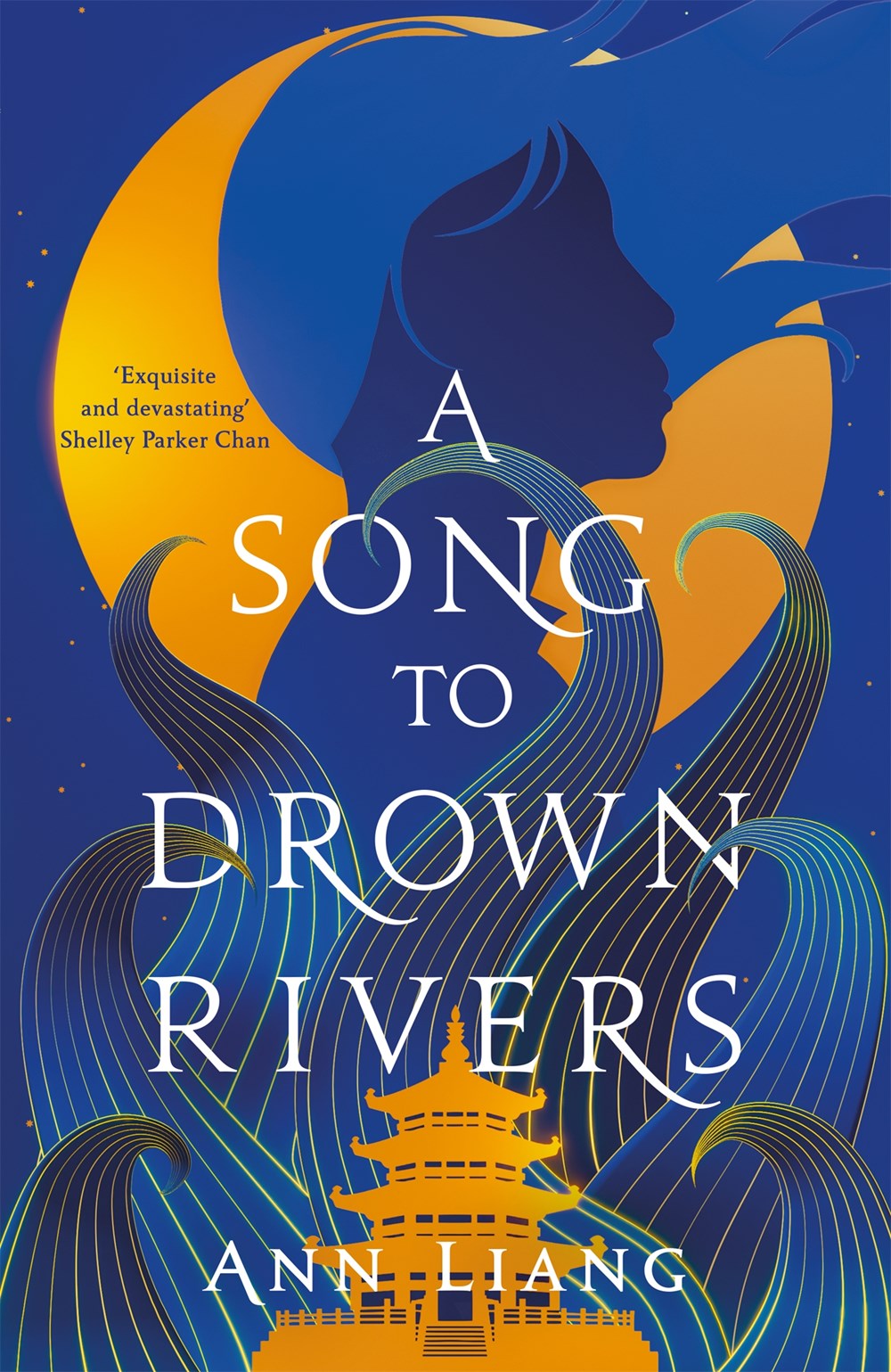
Some stories leave me teary-eyed, not for their endings, though, those do play a part, but for the truth wrapped in every thread of the story. A Song to Drown Rivers flows with many such truths: some sweet like a heart that beasts fast when in love, some bitter like a heart balanced on the edge of a sword. Liang opens adult fantasy based on one of the Famous Four Beauties of Ancient China with a first-person viewpoint of being beautiful. Quickly followed by the first truth: “But girls like me sometimes went missing. Though missing was too soft a word for it. The truth was uglier: stolen, slaughtered, sold.”
When the lens widens and we see past the protagonist, the evidences of enemy soldiers suffocating her village and carrying a history dripping in the blood of her people lay stark against the picturesque riverbank. This is laced with yet another truth that rattles: it is the cruelest fate for the gray-haired to bury the dark-haired. The bloodshed she’d witnessed when mixed with her concern for her family pushes her to accept the opportunity offered by the military adviser to the king, Fanli.

If Xishi draws awe for her beauty, Fanli draws admiration for his sharp mind. An incorruptible, loyal, and calmly determined adviser who devises a plan to overthrow the enemy kingdom ruling above them. Xishi would be the bride for King Fuchai of the Wu Kingdom as a tribute from the Yue. But she would be a bride in only name, and would actually be a spy meant to distract him while the Yue execute an attack.
There’s a certain quietness in this story that almost feels like the silence before a storm—and a storm does come, one that you must experience yourself when reading this book—but the quietness makes way for the fast-beating hearts to echo louder. The romance between Xishi and Fanli simmers so painfully slow, it makes an impact with every little step it takes. Both the characters feel the treachery of what even they thought were their fortified hearts, and despite their attempts at being focused on their mission, the longing only crumbles their walls further.
While Xishi’s beauty is well defined through how the world views her, the narration lets Fanli be defined through her eyes: I could not decide which appearance suited him more: god of war, or muse of poets. To me, he was both. This particular sentence brings me to another impressive aspect of this story: the writing. Lyrical, often poetic, and undoubtedly beautiful, Liang’s writing takes you through characters who are suffocated in their ache for happiness and the inevitability of their duty. “A sharp emotion sliced through me: joy so deep it resembled grief; grief so keen, it resembled joy.” Not only Fanli, even King Fuchai’s presence is dissected with such honesty, he makes a mark in the midst of this yearning couple. A multi-faceted young man who is bound to surprise.
At the core, a war between the heart and the mind continuously unravels. “The heart is a fickle thing: it takes and takes….the mind is dependable, accurate, deadly. It destroys the enemy, not the self, and ensures that we do what we need to, not what we want.” But this tale itself explores the possibility of what your heart wants is exactly what it needs. There’s some political intrigue and the sword that always hangs above a spy gleams with danger, but it’ll be wrong to categorise A Song to Drown Rivers as anything more or less than a love story. This, at the end of it all, is another truth it flows with.
A Song to Drown Rivers, Ann Liang
St. Martin’s Press, Oct 2024
Note: A review copy was acquired via the publicist.
Get the next recommendation from me straight into your inbox! Subscribe here to a newsletter that is all magic.
I'd love to hear your thoughts.