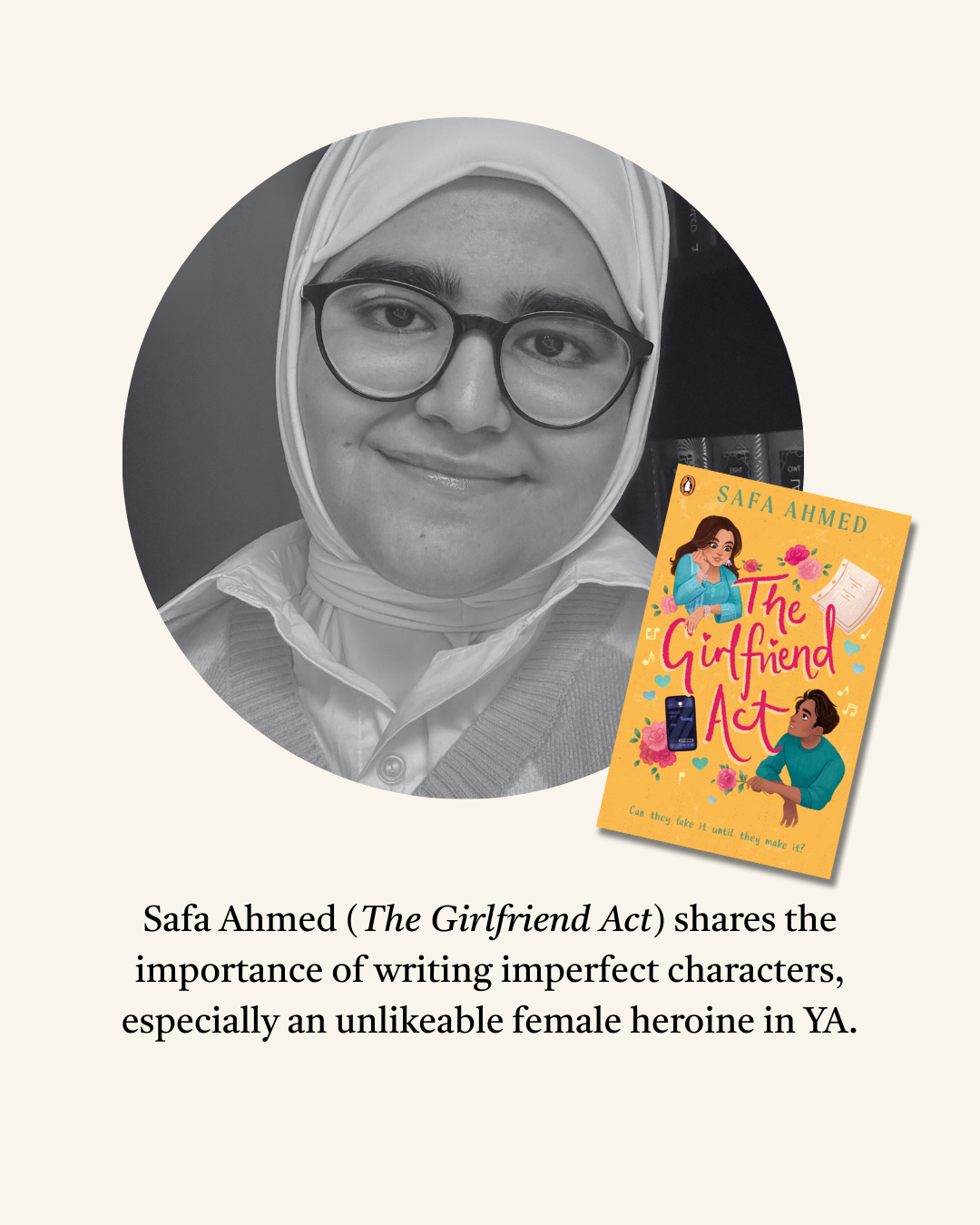
Safa Ahmed’s debut novel is a playful enemies to lovers romance featuring an aspiring actress and an ex-child star. The Girlfriend Act is an epic, fake dating drama that is fuelled by a British Pakistani grumpy-sunshine pairing and a found family, while touching on heavier themes like colourism, identity, and privilege. Farah is tired of being in the background and Zayan needs a break from the spotlight, so when Farah’s band of fellow rejected theatre kids, called The Tragdies, propose a deal to Zayan, he accepts. He must star in and fund a play for The Tragedies in exchange for a regained popularity that the fake romance would bring him. Tracy Badua, author of This is Not a Personal Statement, has praised this debut saying it has “endearing character finding the courage to be true to themselves and their dreams”. It is this courage, especially of an unlikeable female heroine in young adult literature, that Safa Ahmed (The Girlfriend Act, June 2024) writes on here. To view more such posts by debut authors, make sure to check out this collaboration, Debut Dialogues!
The Unlikeable YA Heroine
Safa Ahmed (The Girlfriend Act) shares the importance of writing imperfect characters, especially an unlikeable female heroine in YA literature.
When I first realised The Girlfriend Act was going to be published—after I signed the contract, and it hit me that a lifelong dream of mine was coming true—I felt this sudden wave of fear. And it wasn’t my usual imposter syndrome (that was there of course, which writer exists without it?), but it was a new kind of fear.
I was afraid no one would like my main character. Why? Because I knew, bone-deep, that she wasn’t the ‘perfect female lead’ in a Young Adult book. It was also around this time that the age-old debate about YA literature was going around on social media: how YA books were being given a slew of negative reviews by readers who felt the stories and their main characters—often heroines—were “too much”. They made too many mistakes, they made too many rash decisions, they were not entirely level-headed human beings (or half-magical beings if it was a YA fantasy). But these characters were in the middle of their young adulthood, on the cusp of adulthood, and they made bad decisions to grow. They were complicated, full people.

In The Girlfriend Act, Farah Sheikh is a British-Pakistani aspiring actress, and when she’s given an opportunity to make her dreams of being on stage come true, she grasps it and ends up going down a path that forces her to confront her identity. She battles with questions she never faced before—like what it means to be a British-Pakistani woman who was considered too brown for some, and not brown enough for others. The theatre, her play, and her fake romance becomes a safety net, where she can put on a persona and take on an identity that is not her own. She can escape from the scrutiny of the spotlight, from the fans who dissect her every move, from the eyes waiting to watch her fail or succeed.
But only for so long.
In the end, she knows she must confront her fears, and the looming change in her life, if she ever wants to achieve her ambitions. And in this journey, naïve of her privilege, unaware of how truly dangerous it is, she messes up again, and again—even when her heart is in the right place.
And as I type this out, justifying everything Farah does, I realise that I like writing the complicated female lead. The unlikable one. Because I can’t help but think the label ‘unlikable’ for female characters was chosen to replace something far simpler: imperfect. Female characters who are complicated are just realistic. Especially in Young Adult literature, where entirely self-realised characters who are in touch with all their emotions, and make perfect decisions, would lead to an incredibly dull story.
Going even further, if we were comparing genres, it is those characters—entirely imperfect—who make the adult romance so compelling to read. Let’s step back and look at the classics: Emma Woodhouse, Amy March, Elizabeth Bennet. These are all imperfect, complex female leads who have pushed against the confines of the ‘perfect female’ archetype. Amy March (Little Women) goes from ripping up her sister’s manuscript to a softer, more mature, stronger young woman in the end. Elizabeth Bennet (Pride and Prejudice) must, as the title suggests, overcome her pride alongside Mr. Darcy to achieve her love story. Classic literature has celebrated the complex female leads, and it would be powerful to see that kind of sentiment in Young Adult Literature.
Because YA female leads are expected to be the perfect heroine—the one who always makes good choices, who never strays into morally-grey behaviour, who doesn’t hurt those around her. Her only fault, usually, is falling in love with the male character who is allowed to be imperfect. The male character we all swoon for because he’s imperfect: the bad boy, the class clown, the snobby academic rival. We adore those male characters because it takes them a moment to find their footing, and we’re happy to wait for them to get there. But I’ve found the same courtesy is not always extended to our female counterparts.

Take Katniss Everdeen (The Hunger Games) for example. When I began researching this topic, I was surprised to find several articles on how much people hated Katniss, for reasons I found entirely baffling. She was ‘too annoying’ or ‘too whiny’ or she ‘too distrustful’. We’re talking about a teenage female character who is fighting against a fascist government—who was a symbol for an entire uprising. She faced poverty, she faced brutal abuse, she had resentments, and she still found compassion.
Yet, she was considered unlikeable.
There were reviews that called for her to be even more compassionate, less cold, more loving; but these altered attributes wouldn’t allow for her to be realistically complicated. She wasn’t allowed to be distrustful before she revealed the softer parts of herself; she wasn’t allowed to grow from those moments because she was expected to be the perfect heroine—steadfast and uncomplicated.
But,in the face of all this negativity, there was still an uproar of love for the unlikable—actually, strike that—imperfect YA heroine.This love carries on for other books, for example, Michelle Quach’s Not Here to Be Liked was marketed as having an “unlikeable” main character because young adult readers enjoy seeing their complicatedness reflected in the characters they read about.
These are the same readers who are looking for their Jane Eyres, their Amy Marches, their Elizabeth Bennets in Young Adult Literature that is written with them in mind.
So, this is my answer to every writer who is afraid that their YA heroine is unlikable: you will find your audience. You will find the reader who resonates with your character’s journey; the reader who loves your character for their imperfections. Because it’s for them—those readers who find themselves in our pages—that we pen our stories.

Safa Ahmed is a British-Pakistani content marketer and ever since she scribbled down her first story-a mystery featuring stolen cookies and an incriminating teddy bear-it’s been her dream to be a writer and publish books that celebrate joy, heartbreak, swoony love interests, fierce female characters, and everything in-between. When she’s not writing, she is usually re-reading her favourite fantasy novels, wreaking havoc in the kitchen or expanding her ever-growing TBR pile. You can find her on Twitter, Instagram and TikTok as: @safaswritings
I’d love to hear your thoughts.