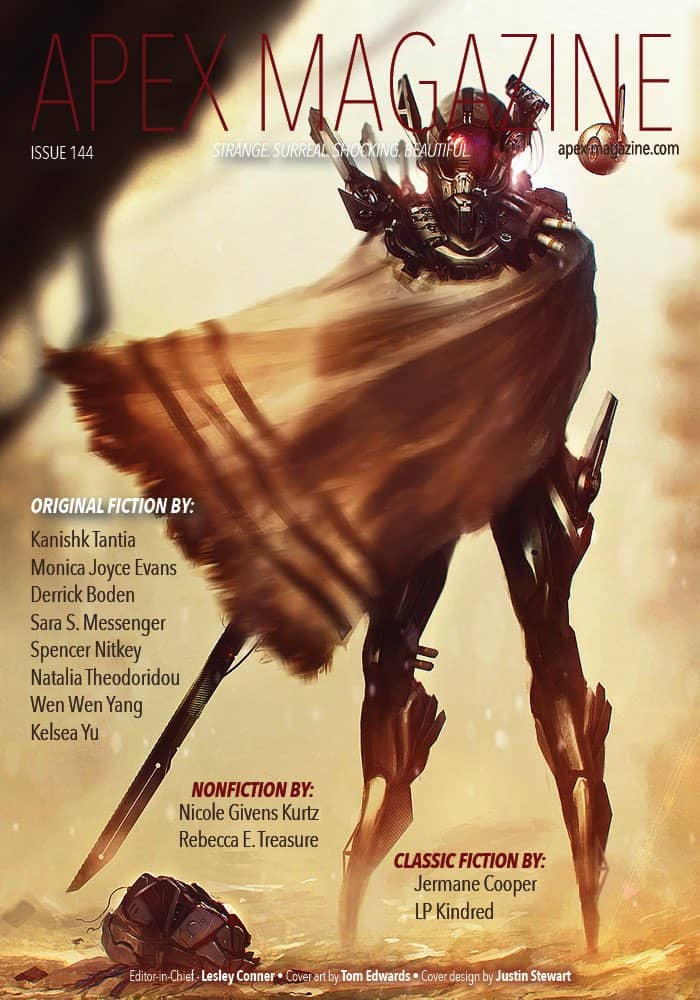
In a future where androids are created to replace dead loved ones, humans leave these droids abandoned in their closed worlds, their closed minds filled with the essence of those they’re programmed to be. Told through such a droid ordered to be Hari, the lost husband of a woman named Rosh, this story gives an insight into a created being as it grapples with its own sense of self, especially in the absence of the human it was designed to be for—its only purpose seemingly lost, its identity expected to be reverted to a combination of numbers and letters: HZ-12. Read: “Those Left Behind” by Kanishk Tantia.
The story opens with a meticulously described scene of a breakfast prepared and turned cold, untouched and uneaten by the wife it was prepared for. “Three pieces of toast—dark on one side, light on the other. A cup of coffee. Rosh’s preference is Blend 14, with hints of Sub-Saharan Africa and caramel, delivered tepid with more milk than expresso.” The attention to detail here emphasises the precision of a lover, or the accuracy of a droid tasked to be the lover. HZ-12 points out how “expresso” is wrong but Hari’s neural map doesn’t allow him to correct Rosh. This imperfection of the word ‘espresso’ underscores the slightest distinction between any android capable and adamant about correction, and a human lover who knows his wife’s eccentricity and lets it be.
A significant part of the narrative centres around HZ-12’s routine, a reflection of Hari’s life and preferences, but this routine is disrupted when Rosh, like the other human residents, suddenly disappears. Its longing, its confusion, and its denial are captured through the continuous effort—even though the effort is put effortlessly for he’s programmed to repeatedly do so—he puts into performing the daily rituals for Rosh. “Waking up fifteen minutes before she does to make her breakfast and do the dishes. Giving her a soft kiss each night before she sleeps, unless I detect a slight rise in blood flow and heat, a slight dilation of the pupils, a subtle second glance asking for the soft kiss to turn into something more. Set by her.”
SB-11, another droid programmed to be the lost wife, Smita, of General Jun Bakshi next door, frequently knocks on Hari’s door, inquiring about Jun and her absence coinciding with that of Rosh. Though, Hari’s neural map always left him optimistic—for Rosh would never cheat on her husband or leave him—and that calmed down Smita too. Soon, both are met with the truth as a Thinker, a more advanced android, informs that all humans have left the planet, leaving the Carers behind. This revelation forces HZ-12 to confront the reality of its situation. “Your designated resident has left.” The phrase “designated resident” shows the soulless interpretation of what HZ-12 is: Hari, someone Rosh loves the most; Rosh, someone he’s meant to love the most. The cold, clinical nature of what HZ-12 should be contradicts the neural map of Hari he must be, and the emotional attachment he feels to this human he’s only impersonating with precision.
With this dilemma and the surprising self-awareness of a droid, the struggle of an identity emerges. Do the memories and the mapping of everything that Hari was is what HZ-12 is? Or is it HZ-12 all by himself and can swiftly dissociate from this human that seems to have seeped further into him than a mere neural map? Or is HZ-12 —Hari— everything he is himself? Everything that feels comfortable to his identity, everything that makes him him. Little details impress, like the conveying of skin colour as Skin™ and the continuous progress in technology worrying droids too, like Doers with seven limbs for a complete range of motion when compared to Carers whose sole function is to embed and mimic a dead human at the command of another human.
The story unravels much more and in excellent depth, from details about the humans’ absence and the future of those left behind, while focusing on the central character as it becomes a human or remains an android, or settles within himself—a complexity similar to the usage of both pronouns for Hari in this review.
Read in Apex Magazine Issue 144; May 7, 2024
I’d love to hear your thoughts.