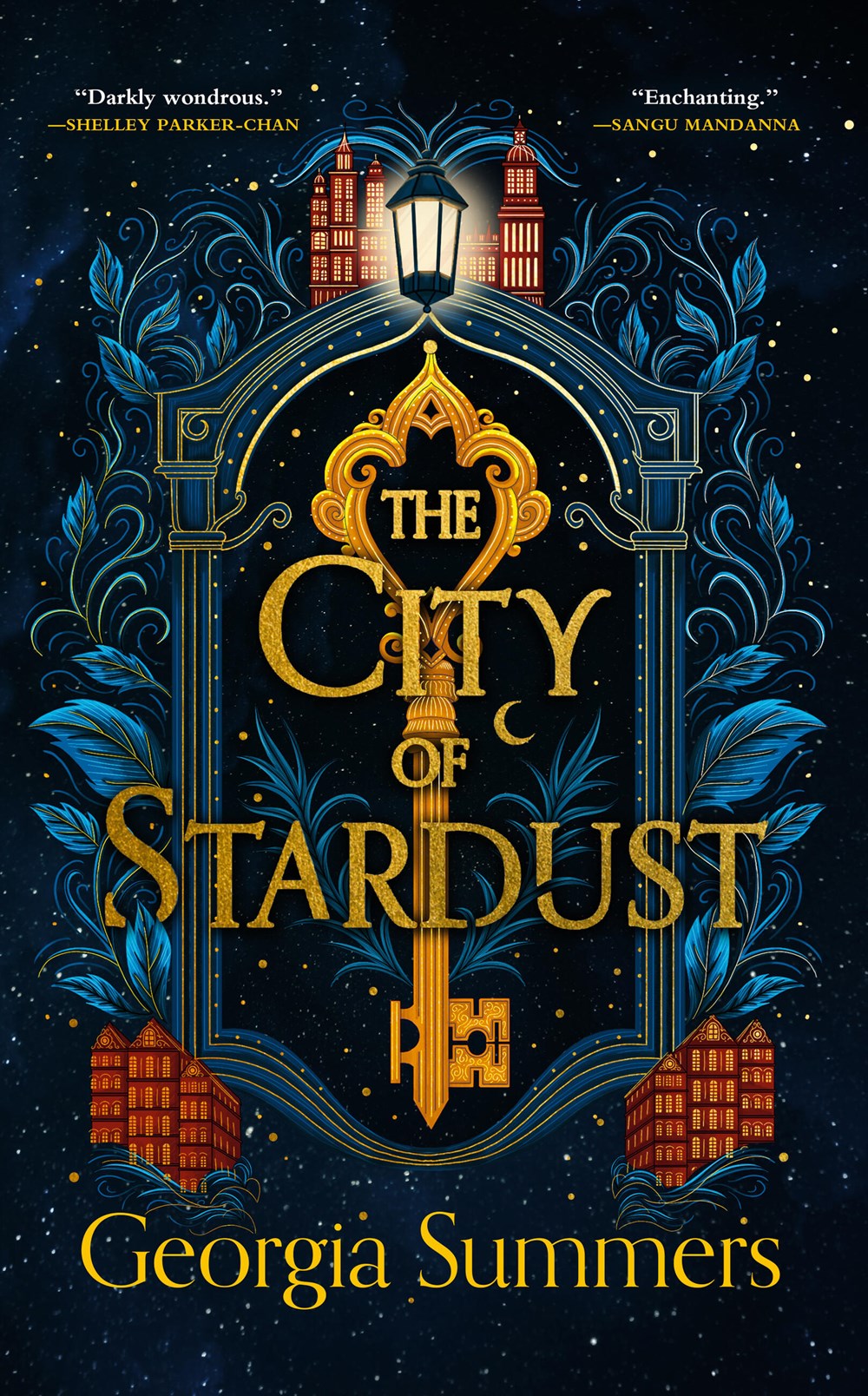
Summers opens The City of Stardust with a prologue that intrigues when children go missing around the world: a baby from his pram, a child of two from Vienna, a boy with grey eyes from Prague. All vanishing away with a woman carrying a strong vanilla scent. At the same time, Marianne is walking into a thunderstorm, leaving behind her little daughter, hoping to find answers for a curse clouding over her family, the Everlys, for years. She takes a worn key from around her neck, turns it in the air—and vanishes. This is also where Summers first impresses with the beautiful writing. Describing a curse like a star falling across the sky, something poetically tragic.
A curse can be many things. A wish left out to spoil in the sun, putrid and soft, leaving behind only calcified desire and oxidised envy. Or a poisoned chalice, a mistake tattooed across an entire family tree, with every generation promising, vowing to never sip until they do. Sometimes, it’s a deal and bad luck conspiring like old grifters closing in on an easy mark.
Everything about this single paragraph lured me into the story, purely through the writing. The way Summers takes an aspect that drives this fantasy and asks you to imagine it in ways that grounds its impact is remarkable. Here, curse isn’t just a prophecy playing out or magic gone wrong. A curse is described through its opposite, as a wish that has degraded over time. Or a wish that one realises too late is an invitation to tragedy, forced to watch it rot itself and everything around.
A curse is then imagined as a “poisoned chalice”—a mistake—whose consequences the family is well aware of, yet a mistake they ultimately make, sooner or later. Here, the inevitability of a generational curse carries the horror of inescapable mistakes that are bound to be repeated. Finally, Summers personifies two sides of the same coin that hold the potential to destruct. After all, a deal gone wrong is basically bad luck playing out with your consent. And bad luck itself is a deal you’ve made with fortune—a deal that doesn’t serve you well. This combination is bound to birth a curse.

Violet, left behind by her mother and under the care of her uncles, has grown up isolated and ignorant about the curse hanging over her family like a sword by a thread. Ten years ago, a mysterious woman named Penelope had visited, warning her uncles to find their sister Marianne in the next ten years or Violet will have to bear the consequences of the Everlys’ curse. Also accompanying the woman was a child named Aleksander—a lonely boy stolen by the woman and brought into her care. He has grown immersed in a magical scholar society that he craves to belong to but never seems to be enough, despite being Penelope’s loyal assistant.
Adjacent to this magical world is a lost city where celestial gods once lived among scholars and artisans. The door to this city remains closed ever since a tragic love story unravelled, and to open it, sacrifices must be made. It’s easy to understand The City of Stardust is a plot-heavy book. But at the core of it, it’s driven by two young characters who are lost yet ambitious to find themselves, find their purpose, and find why others have decided so much for them.
Violet is forced to stay in isolation because her uncles care about her safety, never sharing their own progress or problems as they attempt to search for answers while the clock is ticking on Penelope’s warning. She wants to help, she wants to figure out why her mother left and never came back, and she wants to enter the magical world too. Aleksander is less explosive in his actions, but ambitious about making a place for himself among the scholars. He understands the life given to him by Penelope—which is impossible to forget when she consistently reminds him of where he has come from—and is determined to walk the linear path of serving her purpose in order to achieve his own.
Violet’s curiosity and Aleksander’s obedience often clash as the former runs away in search of clues surrounding her mother’s abandonment and the latter follows her as an informant to Penelope. But deep down, both are longing for more than they’re seeking.
Growing up confined, Violet seeks adventure. Having read books in the vast library of her ancestral home, she searches for freedom in the pages. She accepts that adventure is a “dangerously seductive word” for her: it reaches underneath Violet’s ribcage and pulls, like a cosmic string attuned to a compass point elsewhere. She’s waiting for something, longing for a place other than the house, and that drives her on this search to end the curse.
Aleksander, being under Penelope since childhood, has no dreams of his own. Her longing for the lost city forces him to not crave anything of this world—only look for the gods that once were. His journey forces him to realise he would forever remain “a shadow of all the things he’s not”. And that drives him to realise his feelings for Violet, unravelling a romance that suffers through powerlessness—leaving you both hopeful and hopeless as a reader.
The City of Stardust has a fairytale-esque unfolding. It sets up a plot, a world, and a lore, but majorly orbits everything around the two main characters and takes pride in its prose. So while it reads like a potential trilogy stacked into a single book, you’ll understand it isn’t. Because it builds the world for the characters, lets the plot support the characters, and even pushes the lore to serve the characters. This does mean the story can feel incomplete, like it could’ve explored each of its threads more. But at the end, this book reminded me of The Last Tale of the Flower Bride by Roshani Chokshi—one of my absolute favourites—because it gives exactly what it sets out to, and not what a reader would expect.
This debut is strong because it doesn’t force itself to dive into aspects that would throw it off its purpose. Told through a narrative style of non-linear, short vignettes, this story made me believe in the power of prose. Despite the vastness of concepts like a lost city, an adjacent magical world, a generational curse, the lore of a tragic love story, and antagonists with immense influence, The City of Stardust chose to be solely about Violet and Aleksander. And for that, I enjoyed reading it.
The City of Stardust, Georgia Summers
Hodder & Stoughton, Jan 2024
Note: A review copy was acquired via the publicist.
Get the next recommendation from me straight into your inbox! Subscribe here to a newsletter that is all magic.
I'd love to hear your thoughts.